1. Introduction
Milk carton packaging changed the dairy industry in the early 1900s. Before cartons existed, fresh milk used to spoil quickly and could not easily be sold in retail stores. Today, customized, high-quality milk cartons exist to protect milk from bacteria, heat, and humidity, keeping it fresh from the farm to the store shelf.
Whether you are running an established dairy farm or launching a brand-new plant-based milk line, getting your packaging dimensions right is critical. If your boxes are just a fraction of an inch off from the right size, they will not fit correctly on grocery store shelves, they will cause shipping issues, and they could even lead to costly product leaks.
In this guide, we will break down exactly how to measure your milk cartons, explore standard industry sizing charts, and help you select the best materials to keep your products fresh as new.
2. Why Choosing the Right Milk Carton Dimensions Matters?
Modern milk cartons are not just milk containers. Branding plays a huge role in packaging these days. They serve as a vital marketing tool and act as a shield for your product. Getting the exact dimensions right helps your business in three major ways:
-
Flawless Shipping and Stacking: Milk cartons feature a space-saving rectangular design. When your dimensions are precise, you can stack the boxes tightly inside crates without leaving empty gaps or crushing the containers.
-
Perfect Retail Shelf Fits: Commercial grocery store shelves and refrigerator doors have strict height limits. Correct measurements ensure your product slides smoothly into place.
-
Vending Machine Compatibility: Smaller sizes, like the school half-pint, must be exact to prevent jamming in standard vending machine drop slots.
3. Understanding the Materials Inside and Out
A milk carton cannot rely on plain paper alone. Because it holds liquid, it requires specialized, food-safe layers.
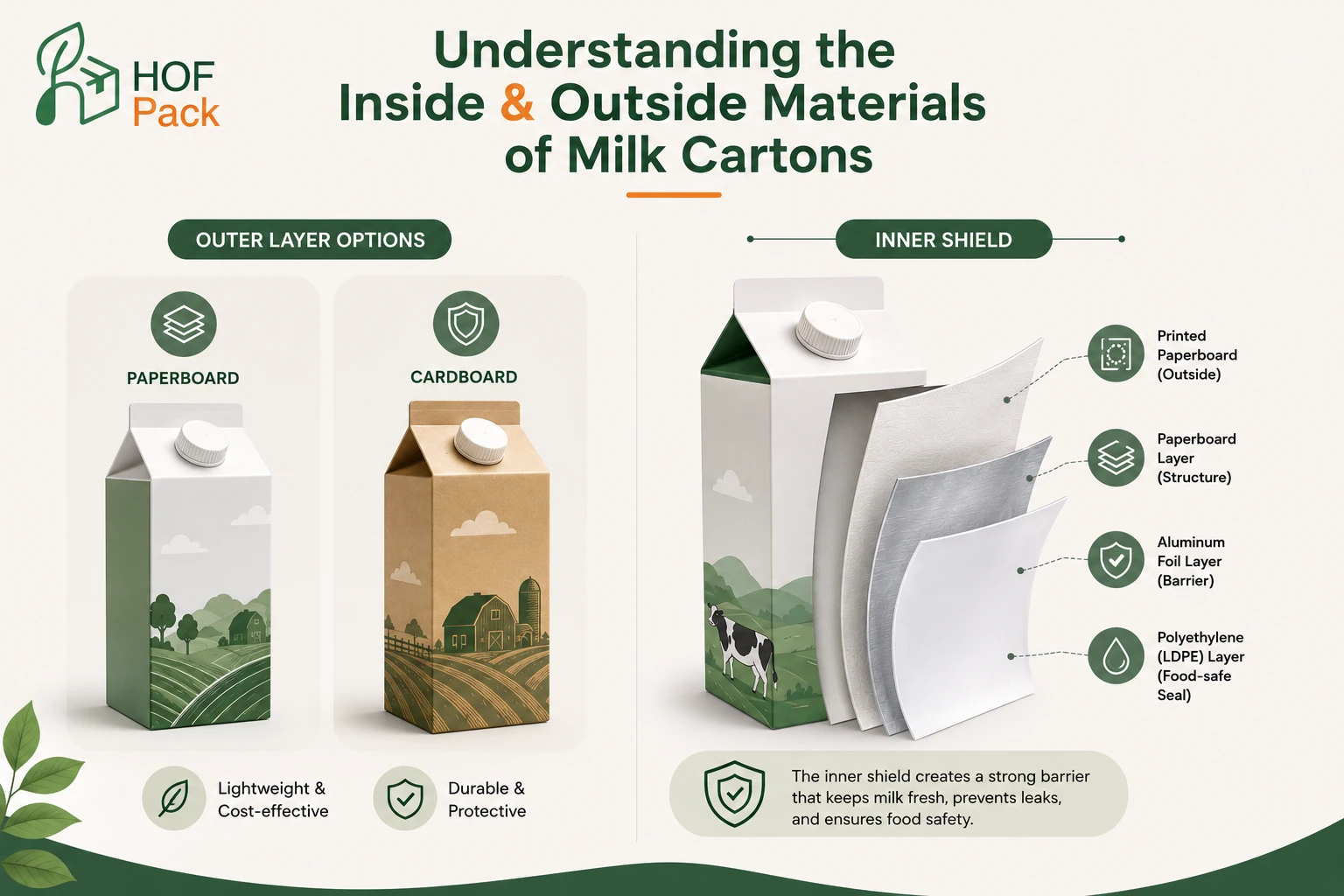
The Outer Layer Options
-
Paperboard: The most common choice. It is lightweight, cost-effective, and provides a smooth, flat surface for bright custom printing.
-
Cardboard: A thicker, sturdier option used for larger capacities. It provides extra protection against bumps and drops during transit.
The Inner Shield
If you look inside a torn carton, you will see a shiny or smooth lining. Manufacturers use a thin layer of Polyethylene (LDPE) plastic or a micro-layer of Aluminum foil. This inner barrier is completely food-safe and prevents the milk from soaking through the paperboard, ensuring zero leaks.
4. Standard Milk Carton Sizing Guide
Milk carton capacities are traditionally measured in fluid ounces (oz) within the US market. The table below lists the standard industry dimensions in both inches and centimeters.
Milk cartons are manufactured in several standard sizes to accommodate different beverage volumes. The Half-Pint (School Size) carton typically holds 8 oz (236 ml) and is commonly available in dimensions of 2.25" × 2.25" × 2.75" (5.7 × 5.7 × 7 cm) or 2.8" × 2.8" × 4" (7.1 × 7.1 × 10 cm). The Pint carton has a capacity of 16 oz (473 ml) and usually measures 2.75" × 2.75" × 4" (7 × 7 × 10.2 cm) or 3" × 3" × 4.5" (7.6 × 7.6 × 11.4 cm).
For larger beverage packaging, the Quart carton holds 32 oz (946 ml) and is generally produced in dimensions of 2.75" × 2.75" × 7.5" (7 × 7 × 19 cm) or 3.6" × 3.6" × 8.3" (9.1 × 9.1 × 21 cm). The Half-Gallon carton is designed for 64 oz (1.89 liters) and commonly comes in sizes of 5.06" × 4" × 5.12" (12.8 × 10 × 13 cm) or 6" × 4" × 8" (15.2 × 10 × 20.3 cm).
The largest standard option is the Gallon carton, which holds 128 oz (3.78 liters). Standard gallon milk carton dimensions are typically 7" × 4" × 7.5" (17.8 × 10 × 19 cm) or 7.5" × 4.5" × 8" (19 × 11.4 × 20 cm). These industry-standard dimensions may vary slightly depending on the manufacturer, carton design, and packaging requirements, but they serve as reliable reference measurements for most dairy and beverage packaging applications.
5. Step-by-Step: How to Measure Your Milk Carton
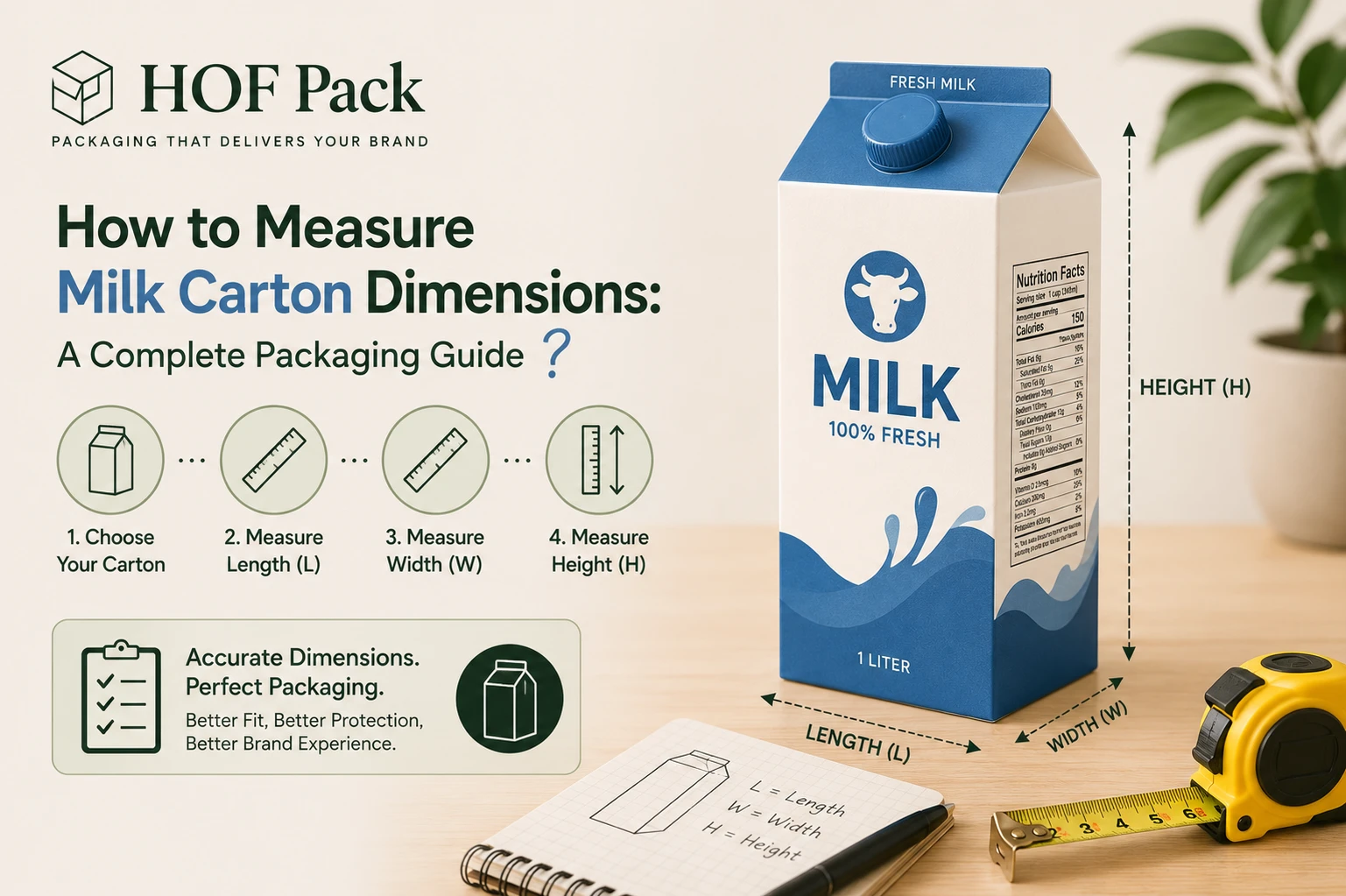
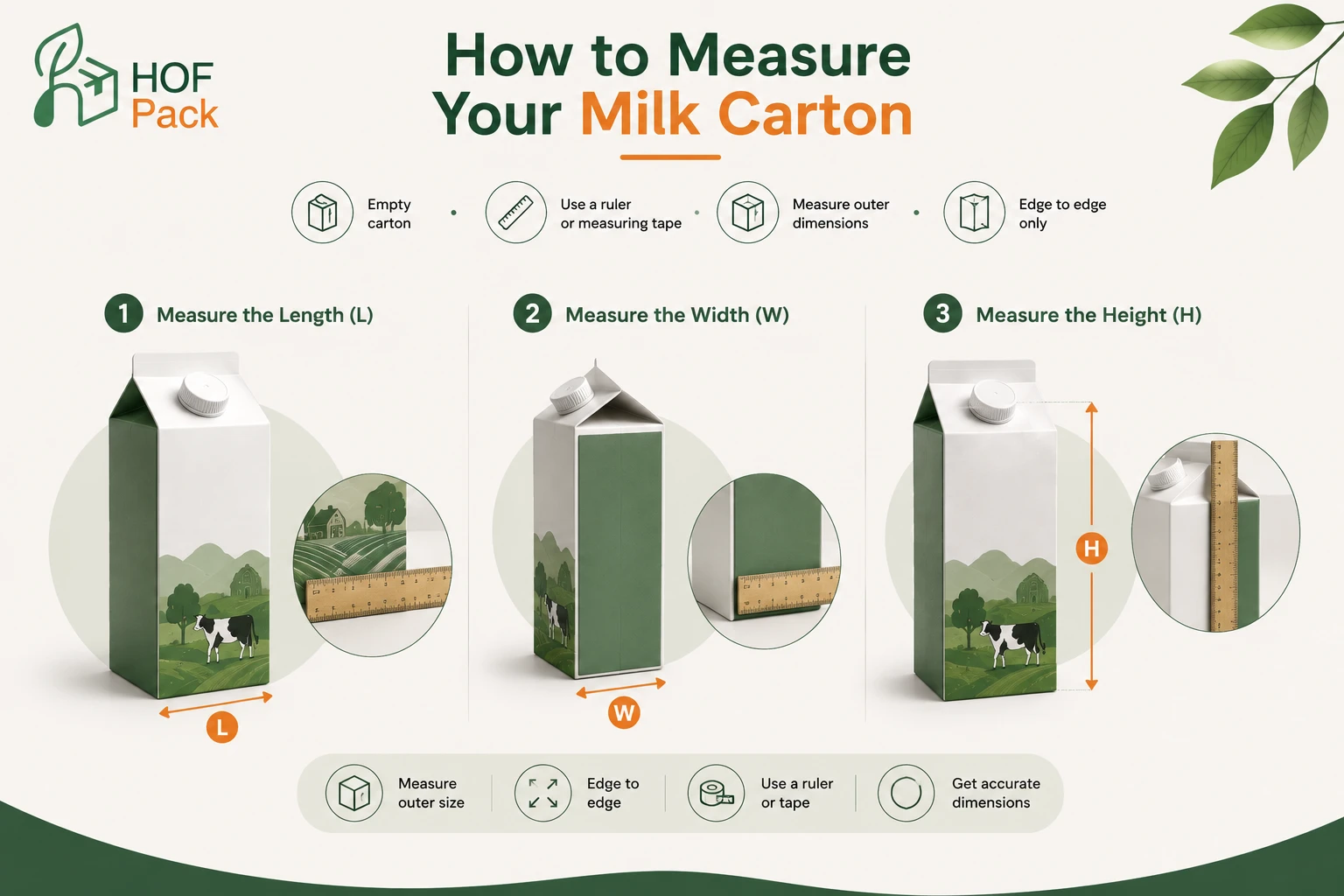
To find the exact measurements of a carton, place the empty box flat on a table. Grab a hard ruler or a standard measuring tape. Always measure the outer dimensions from edge to edge.
Step 1: Measure the Length (L)
Look at the front face of the carton. Measure the flat horizontal distance from the left corner to the right corner. Do not include any loose side flaps or overhanging tabs.
Step 2: Measure the Width (W)
Turn the carton to its side panel. Measure the horizontal distance from the front edge to the back edge. This tells you how deep the box is.
Step 3: Measure the Height (H)
Measure vertically from the absolute bottom base of the carton straight up to the top. The height may differ from style to style.
Below is a guide to measure the liquid volume for different styles of boxes:
6. How to Calculate the Liquid Volume
Different carton shapes use different formulas to find how much liquid they can hold.
For Square and Rectangular Cartons
Most standard cartons use a flat rectangular or square base. To find the internal volume, use this simple formula:
Volume = Length x Width x Height (to the roofline) V = L x W x H
For Cylindrical Cartons
If your brand uses round, tube-style paperboard containers, you will need to find the radius (half of the total width across the circular top) and use the cylinder formula:
Volume = pi x r^2 x Height (πr2h)
For Gable Tops
If your carton has a roof-like sloping "gable top," measure the height up to the point where the roof begins for liquid volume calculations. For total shelf-clearance measurements, measure all the way to the very peak of the top seal, including any screw caps.
7. Common Measurement Mistakes to Avoid
Last but definitely not least, brand owners usually make some common mistakes while measuring the cardboard milk carton dimensions. As a packaging expert, we must forbid you from making some common measurement mistakes.
Ignoring Wall Thickness:
If you only measure the absolute outside of a thick cardboard container, your internal liquid capacity might end up smaller than expected. Always talk to your manufacturer about wall thickness.
Forgetting the Pour Spout:
If your carton uses a plastic twist-off screw cap or a pull tab, ensure you add that extra height to your calculations so it fits inside shipping crates comfortably.
Rounding Off Metric Conversions Early:
If you are converting inches to centimeters, don't round your numbers too early. Multiply the exact inch value by $2.54$ to avoid slight sizing errors.
8. Get Perfect Custom Dimensions with HOF Pack
You do not have to figure out complex packaging math alone. At HOF Pack, we help dairy and beverage brands design the exact carton sizes they need to stand out on retail shelves.
We provide completely free design assistance, digital flat templates, and realistic 3D mockups before you spend a dime on production. With flexible MOQ units, factory-direct wholesale pricing, and lightning-fast 8–12 day turnarounds, we make getting the perfect box simple.
Ready to build your custom carton? Contact our friendly packaging experts today at info@hofpack.com or call us at +1 (888) 429 4881 for a completely free consultation!
HOF Pack Team
Custom Packaging Experts at HOF Pack